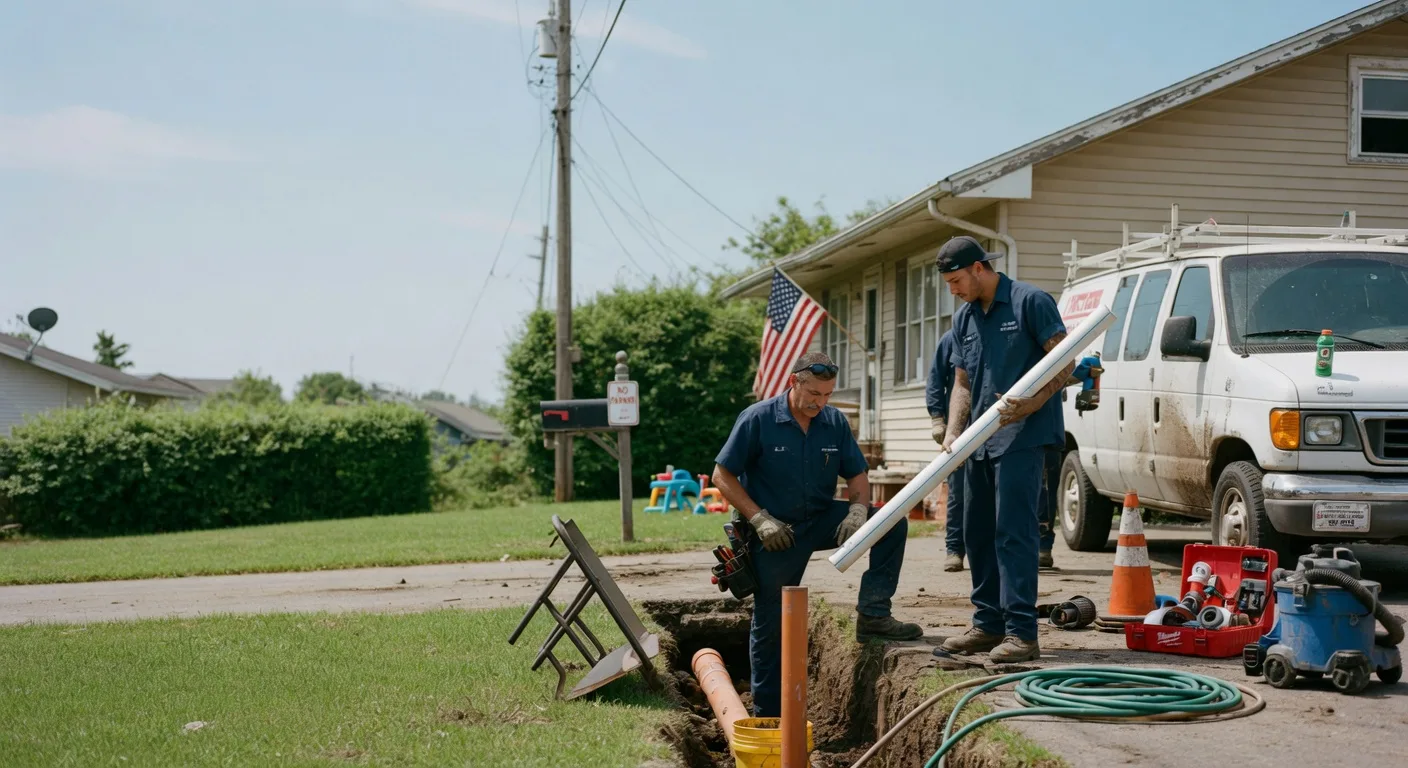
Why did my drains stop working in freezing weather?
Every drain in the house is slow or dead, something is gurgling, and it started on a hard-frost morning. Where Sharpsburg, IA gets a hard freeze, that usually points to ice in a pipe or ice at the top of the vent stack.
Frozen lines first. In colder states a sewer lateral can sit shallow enough for frost to reach it. Any sagging section holds a little water, and that water turns to ice. An un-insulated drain in a crawlspace or garage can freeze the same way.
Then the vent stack. Warm, damp air rises through the vent and meets freezing air at the roof opening. Frost builds ring by ring until the opening closes. With no air coming in, drains cannot flow. That is the gurgling you hear.
A frozen line and a root blockage look identical from inside the house. Both give slow drains and standing water. The weather, or a camera inspection, tells them apart.
Do not pour boiling water down a frozen line. Sudden heat can crack cast iron or split a trap, and then you have a leak too.
Safe homeowner check: see whether one fixture is slow or every drain is, look at the roof vent from the ground, and feel exposed pipe for a cold, stiff section.
Stop running water and call now if every drain is backing up, water is rising in a tub or floor drain, or you smell sewage. A single slow sink is usually a trap or branch job a cable machine can clear. A whole-house freeze-up or a suspect lateral may need a camera inspection, thawing equipment or hydro jetting, which is where emergency drain cleaning comes in.
Expert Plumbers Co is a referral service. We connect you with an independent local plumber in Sharpsburg, IA. Call (380) 262-9173.
Once the thaw is done, expect the problem to come back unless the cause is fixed. If a shallow section froze, ask the plumber to note its depth and whether the pipe has a belly that holds water, since that spot will freeze again. A cold crawlspace or garage drain can be wrapped with pipe insulation, and heat tape made for drain lines can help in short cold snaps, but it must be installed to the maker's instructions. For a frosted vent, keep snow clear around the roof opening, and tell the plumber if the vent is narrow, since a wider vent closes up less quickly. In older homes the vent opening is often smaller and the drains less well insulated, so the same cold snap hits harder. After a freeze, watch for leaks at joints and traps as the ice melts, because expanded pipe can split quietly and only show water once it warms. If you see damp spots later, tell the plumber what happened.
Does hard water cause drain problems, or only water heater problems?
The bathroom sink used to run fine. Now it drains a little slower each month. That slow creep is the sign of scale, not a clog.
Hard water does more than coat a water heater. Minerals from the supply side leave a chalky layer inside a trap. In a bathroom line they bind with soap residue into a hard, grey film. The bore narrows a fraction at a time, so you notice a gradual slowdown rather than a sudden blockage.
Old cast iron is a different problem. Inside drain pipe that has been in the ground or a wall for decades, rust forms lumpy mounds called tubercles. These are not hard-water minerals. They are the pipe corroding from within, and they snag grease and paper.
The two tools do different work. A cable punches a hole through the build-up. Water drains again, but the scale stays on the wall and the line narrows again. Hydro jetting strips the wall back to the pipe surface.
Jetting old iron hard without looking first is a gamble, because thin, flaking pipe can fail under pressure. That is why a camera inspection comes first on old iron. It shows wall condition and cracks before anyone sets the pressure.
Safe homeowner check: find out whether one fixture is slow or every drain in the house is, then clean the visible stopper and trap.
Stop running water and call now if several drains slow together, or water backs up at a floor drain. One slow bathroom sink is usually a cable or trap job. A whole-house slowdown in old iron often needs a camera first and possibly jetting.
Expert Plumbers Co is a referral service. We connect you with an independent local plumber in Sharpsburg, IA. Call (380) 262-9173.
A water softener changes the picture a little, and it is worth telling the plumber if you have one. Softened water leaves less mineral scale, but it can feel slippery and does not stop soap and hair from building up on the pipe wall. If your water is hard and you have no softener, the mineral film inside traps and short branch lines is the main cause of the slow creep. A simple habit helps: use a hair catcher in the tub and basin, and rinse the sink with hot tap water after use so soap does not cool and settle on the wall. Do not rely on vinegar or store-bought descalers to clear a drain, as they only treat the surface. In newer homes with plastic pipe, scale is mostly a trap and fixture issue. In older homes with iron or galvanized pipe, scale and corrosion together can narrow a line enough that replacing a section is more sensible than repeated cleaning.
Can a drain under a concrete slab be cleared without breaking the floor?
Usually, yes. Clearing a blockage and repairing a broken pipe are two different jobs, and only the second one needs the floor opened.
In a slab-on-grade house the drain lines run inside or beneath the concrete. There is no crawlspace to inspect, so symptoms are the only evidence you have. A cable or a hydro jetter still reaches the line through a cleanout or through a pulled toilet. Grease build-up on the pipe wall, roots in a joint and scale in cast iron can all be cleared that way.
What does need the floor opened is a cracked, collapsed or bellied section under the slab. A bellied line holds water and collects waste however often it is cleared. In older housing stock where clay or cast iron was the standard, failed sections are more likely.
A camera inspection with a locator pinpoints the fault. The plumber finds the exact spot and marks it on the floor before anything is cut, which keeps the opening small. What the job involves is driven by access, the materials, how much concrete must be opened and removed, and any permit or code requirement. Opening a slab often brings one in.
Safe homeowner check: note whether one fixture is slow or every drain is affected. A single slow fixture is usually a cable job on a branch line. Every drain backing up points to the main line or the sewer lateral.
Stop running water and call now if the whole house is backing up. Report water staining or a warm, damp patch on the floor, because it can mean a leak under the slab.
Expert Plumbers Co is a referral service. We refer homeowners in Sharpsburg, IA to an independent local plumber. Call (380) 262-9173.
A spot repair under a slab is more disruption than most people picture. The plumber breaks out a section of concrete, digs down to the pipe, replaces the damaged length, and the floor is patched. Dust, noise and a few days without some fixtures are normal. Furniture and flooring over the area must be moved first, and tile or a finished floor may not match after patching.
For longer runs of damage, some plumbers can line the pipe from inside, or route a new line overhead or outside the house, which avoids cutting the slab. Whether either suits your pipe depends on its condition and on local code.
Ask to see the camera footage and the locator mark on the floor before any cutting begins. Mention in-floor heating, radiant tubing or a post-tension slab if you have one. Cutting into those without knowing is dangerous, so the plumber needs to hear about them before a saw comes out.
There is a soggy strip, a sinkhole or an unusually green line of grass over where my sewer runs. Is that a broken sewer line?
It can be. A wet strip, a dip in the lawn or a stripe of grass that is greener than the rest, all following the path of the sewer, is a classic sign that the pipe is leaking into the soil. Waste water carries nutrients, so the grass above it grows lush while the ground underneath stays soggy.
A sinkhole is more serious. If soil is washing into a cracked or separated pipe, it leaves a void that grows over time. The surface may look fine until the roof of that void gives way. Keep people, pets and vehicles off the area and do not fill it yourself with a quick load of dirt, because the hole will usually return.
Other things can look similar, so check before assuming. A leaking irrigation line, a broken water supply pipe or a downspout discharging at that spot can all soak a strip of lawn. A simple test: shut off every tap and appliance, then look at your water meter. If it keeps moving, the leak is likely on the supply side, not the sewer. If the meter is still, and you also notice slow drains, gurgling, a sewage smell outdoors or backups, the sewer is the stronger suspect.
Safe checks you can do:
Note where the wet or green strip runs and whether it lines up with the cleanout or the path to the street. Reduce water use until the line is looked at.
Stop running water and call now if sewage is surfacing, a hole is opening, or drains inside the house are backing up.
Cleaning alone does not fix a broken pipe. A camera inspection is how a plumber finds the break, shows how far the damage runs and tells whether the pipe is cracked, offset at a joint or collapsed. Repair can then be a spot repair, a liner through the existing pipe, or replacement of a section. Cost is driven by depth, length of pipe affected, what sits on top of it such as a driveway, trees or a patio, how much has to be excavated, the pipe material and permits under local code. To be connected with an independent local plumber in Sharpsburg, IA, call Expert Plumbers Co on (380) 262-9173.
Our older house has a house trap, or running trap, in the basement. Why does it keep clogging?
Your basement drain backs up every so often, and each time someone points at the house trap and clears it again. In an older house that is a familiar story.
A house trap, also called a running trap, is a U-bend on the main drain near the foundation wall, with two cleanout plugs. It holds water to keep sewer air out. The trouble is that the dip slows the flow and gives solids a place to settle. Paper, grease, wipes and roots that pass through a straight pipe pile up in the bottom of the bend, so the trap becomes a frequent stoppage point.
Old lines make it worse. Scale in cast iron roughens the pipe and catches debris before it reaches the trap. Root intrusion at a clay joint outside sends fibres toward it. A bellied line downstream can hold water back so the trap never fully clears. Many traps were removed over the years, and local code on keeping or removing one varies.
One slow fixture is usually its own branch problem. If toilets, tubs, sinks and the washer all slow down together, or the floor drain bubbles, the trap or the main beyond it is the likely spot.
Safe homeowner check: Stop using water and look at the two trap plugs without opening them. Check whether the floor drain is holding water, and note which fixtures back up first.
Stop running water and call now if sewage is coming up from a floor drain or shower, if you smell sewage in the basement, or if a plug is weeping. Never loosen a trap plug under pressure, because sewage can surge out.
A cable machine is often enough to clear the trap itself when the stoppage is soft. Hydro jetting is the better choice when grease or scale lines the pipe on either side. A camera inspection is the right step when the trap keeps clogging, because it shows whether the real fault is a belly, a root-filled joint or a failing section further down.
Expert Plumbers Co is a referral service. We connect you with an independent local plumber in Sharpsburg, IA. Call (380) 262-9173.
Ask whether the trap can stay and be cleaned when needed, or be removed where code allows. The scope depends on basement access, the condition of the pipe on both sides, how much floor has to be opened up, and any permit or code requirement for changing the main.